
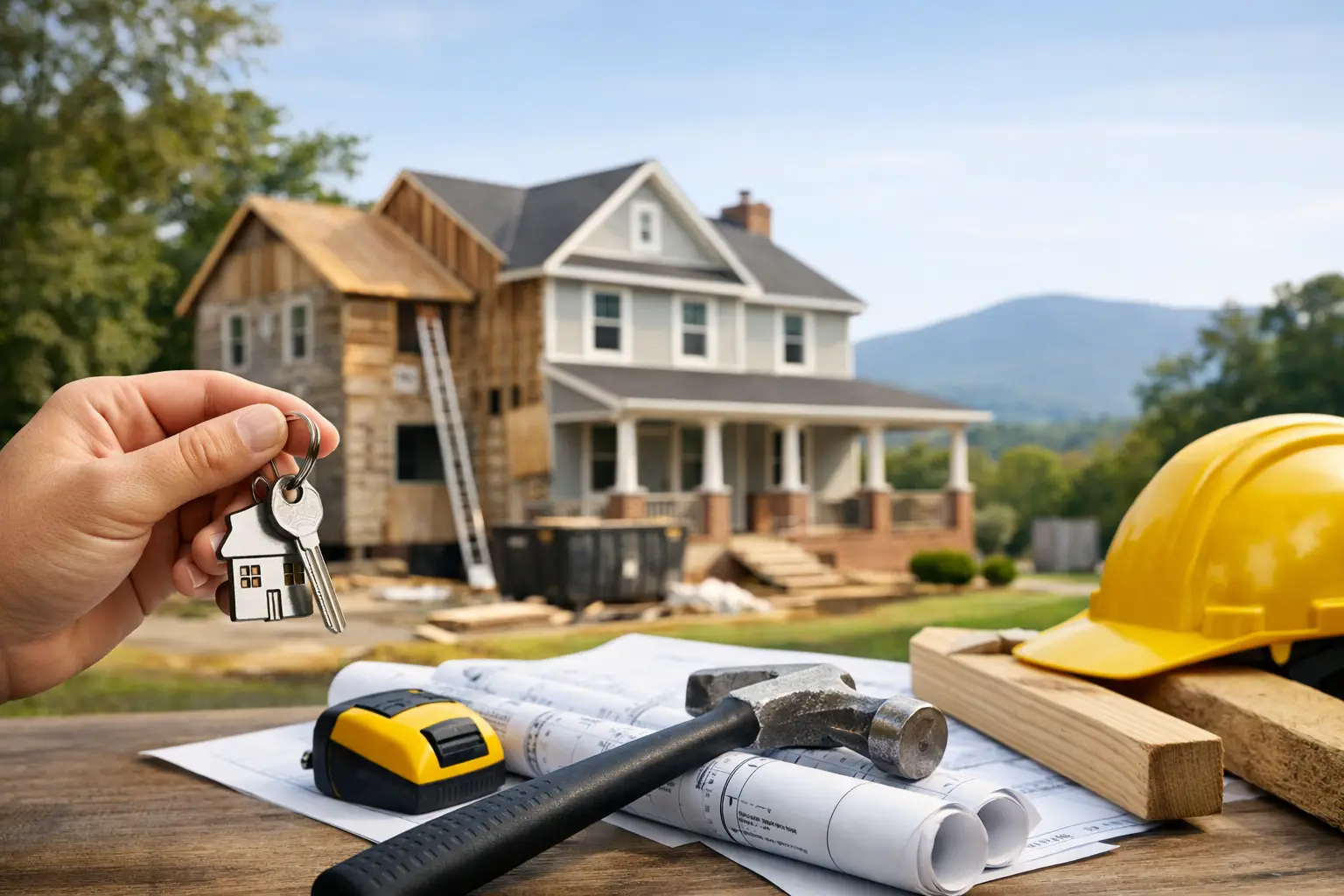

A $325,000 fixer-upper in Chesterfield with $45,000 in repairs can look cheap until the math changes. Using an FHA 203k loan, the total financed amount might land near $370,000 before upfront mortgage insurance and closing costs, and the monthly payment can run about $280 to $420 higher than buying a similar home in move-in condition with fewer repairs. Over five years, that difference can add up to roughly $16,800 to $25,200, which is exactly why an FHA 203k loan review matters before you commit to a house with old HVAC, a tired roof, or a kitchen from 1994.
By Duane Buziak, Mortgage Maestro, NMLS#1110647.
The appeal of the 203k is simple. It lets you buy or refinance a property and roll approved renovation costs into one FHA-insured mortgage. For Virginia buyers who keep losing bids on fully updated homes in places like Midlothian, Glen Allen, or Richmond’s near-west neighborhoods, that can be a practical path into a market where turnkey homes often command a premium.
FHA 203k loan review: what this loan actually does
An FHA 203k loan is designed for owner-occupied properties that need work. Instead of taking out one mortgage for the house and another loan or credit line for repairs, you finance both together. The loan amount is generally based on the home’s projected value after improvements, subject to FHA rules, contractor bids, and appraisal support.
There are two versions. The Limited 203k is for smaller, non-structural repairs. The Standard 203k is for larger projects and typically requires a HUD consultant. If the work involves structural changes, room additions, major foundation issues, or anything that makes the property uninhabitable during repairs, the Standard version is usually the one to review first.
For buyers in Virginia, local price points matter. Recent median home values and list-price patterns often place Chesterfield and Henrico below some of the higher-cost coastal and university-driven pockets, while Albemarle can run materially higher. In practical terms, a buyer trying to renovate a dated ranch in Chesterfield has a different 203k feasibility window than a buyer attempting the same strategy near Charlottesville, where acquisition costs alone may crowd the FHA county loan limit. HUD county limits and FHA program rules are the first filter, not the property wish list. See https://www.hud.gov/program_offices/housing/sfh/ins/203k and https://www.hud.gov/program_offices/housing/sfh/lender/origination/mortgage_limits.
Where the numbers work – and where they do not
The 203k tends to work best when the as-is property is discounted enough that the all-in cost still makes sense after repairs, contingency reserves, financed fees, and mortgage insurance. That sounds obvious, but many buyers underestimate the spread.
Say a home in Henrico is listed at $290,000 because it needs $35,000 in updates. If a comparable renovated home sells around $355,000, the 203k could pencil out. But if contractor bids climb to $55,000, the financed total may approach or exceed the value of simply buying the renovated home. At that point, the loan is still possible, but not necessarily smart.
Virginia buyers should also pay attention to reserves. On many 203k projects, lenders require a contingency reserve of 10% to 20% of repair costs. If utilities are off or the property condition is uncertain, that reserve can lean higher. On a $40,000 rehab budget, that means another $4,000 to $8,000 built into the project. That buffer protects against cost overruns, but it changes affordability.
FHA 203k loan review: key qualifications
FHA is more flexible than conventional renovation financing, but flexible does not mean loose. Most lenders want at least a 580 credit score for 3.5% down, though overlays can push the practical minimum higher. Scores from 620 to 660 usually produce a smoother approval than marginal files, especially when contractor documentation or appraisal conditions get complex.
Debt-to-income ratio matters too. FHA can allow higher ratios than many conventional programs, but compensating factors still matter – cash reserves, stable employment, and documented payment history. If a borrower is self-employed, the review becomes more document-heavy because income must be supported through tax returns or acceptable alternative documentation under the lender’s guidelines.
Closing costs are another point buyers miss. In Virginia, total buyer closing costs on an FHA 203k often run around 3% to 5% of the purchase price when you combine lender fees, title charges, prepaid taxes and insurance, escrow setup, and renovation-related administration. That range can shift based on rate, seller concessions, and locality.
Comparison table: FHA 203k vs other ways to buy and renovate
| Option | Best for | Down payment | Credit flexibility | Repair scope | Trade-off | |—|—|—:|—|—|—| | FHA 203k Limited | Cosmetic or moderate repairs | 3.5% minimum with qualifying score | Moderate to strong | Non-structural only | More paperwork than standard FHA | | FHA 203k Standard | Major rehab, structural work | 3.5% minimum with qualifying score | Moderate to strong | Broadest FHA rehab scope | Consultant, draw process, longer timeline | | Standard FHA loan | Move-in ready homes | 3.5% minimum with qualifying score | Strong | Minimal repair tolerance | Cannot finance major rehab | | Conventional renovation loan | Strong-credit buyers | Often 5%+ | Tighter than FHA | Broad, lender-specific | Higher score expectations | | Separate purchase plus personal funds | Buyers with cash reserves | Varies | Varies | Flexible after closing | Cash drain and no rehab financing leverage |
The timeline is longer than buyers expect
A regular purchase might move from contract to closing in 30 days. A 203k often needs more time because the lender is underwriting not just the borrower and property, but also the repair plan. Contractor bids, consultant reports, feasibility review, after-improved appraisal, and escrow setup all add steps.
Forty-five to 60 days is a more realistic planning range, and some files take longer. In competitive pockets of Richmond, Williamsburg, or Virginia Beach, that longer closing window can make sellers hesitate. This is one reason some buyers lose fixer-upper deals even when the financing is valid.
Consumer guidance on mortgage shopping and loan estimates is worth reviewing before comparing lender fees and rate structure: https://www.consumerfinance.gov/owning-a-home/loan-estimate/.
How FHA 203k compares with big lenders and local competitors
The real difference is usually not the base program. FHA rules are FHA rules. The difference is execution. Large call-center lenders may offer broad availability but can struggle when contractor packages are incomplete, appraisals come back subject-to, or a seller pushes for a faster answer. Regional banks and mortgage bankers may be stronger operationally on renovation files, but fees and overlays vary widely.
Compared with lenders such as Rocket, Movement, Atlantic Coast, NFM, CMG, Alcova, C&F, CrossCountry, or Freedom, the questions worth asking are specific: What is the minimum score for 203k? How many 203k loans did the team close in the last 12 months? Do they allow borrower-selected contractors? How do they handle contingency reserves? What are the inspection draw fees? A low advertised rate is not much help if the file stalls in underwriting.
6-step roadmap to decide if a 203k fits
- Price the house as if you were buying it tomorrow. Use realistic local comps, not best-case renovation hopes.
- Get written contractor bids before you get emotionally attached. Ballpark estimates are not enough for a serious review.
- Add contingency reserves of 10% to 20%, then model the payment with FHA mortgage insurance included.
- Compare that all-in number against nearby move-in ready homes in the same school zone or commuting corridor.
- Check your credit score, cash to close, and debt ratios before making an offer. Soft-pull prequalification helps here because it protects credit while you test payment scenarios.
- Ask the lender how many days they need for a clean 203k closing and build that into your contract strategy.
FAQ
Is an FHA 203k only for first-time buyers?
No. It is for eligible owner-occupants, whether first-time or repeat buyers.
Can I use a 203k for an investment property?
Not as a standard non-owner-occupied investment loan. FHA 203k is primarily for owner-occupied properties.
What credit score do I need?
Many lenders start around 580 for 3.5% down, but stronger approvals are more common at 620 and above.
Can I do the work myself?
Usually no, or only in very limited circumstances if the lender allows it and documentation is strong. Most files rely on licensed contractors.
Does the loan cover luxury upgrades?
No. Repairs and improvements must meet FHA eligibility standards. Think functional updates, safety, livability, and value support, not high-end extras.
How much cash do I need besides the down payment?
Plan for down payment plus closing costs, and be prepared for possible appraisal gaps or items the loan will not finance.
Can I finance mortgage payments while the home is unlivable?
In some Standard 203k cases, limited mortgage payment reserves can be financed during renovation if program rules are met.
A fair fha 203k loan review comes down to discipline. If the purchase price is right, the contractor is documented, and the all-in payment still fits your budget after taxes, insurance, and mortgage insurance, the program can turn an outdated property into a workable long-term home. If the repair budget is fuzzy or the deal only works under perfect assumptions, it is usually better to know that before the inspection clock starts.
This article is for educational purposes only and does not constitute financial or legal advice.
Duane Buziak, Mortgage Maestro | NMLS: 1110647 | Licensed VA/TN/GA/FL | VA Broker of the Year 2024-2025 | Top 1% Nationwide | Coast2Coast Mortgage | (804) 212-8663.