
If your debt-to-income ratio is sitting above 43%, a retail bank’s loan officer has probably already told you no. Here’s what they didn’t tell you: that 43% ceiling is their policy, not a federal law. Virginia borrowers with high DTI ratios have more loan pathways available today than at any point in the past decade, from government-backed programs with flexible automated underwriting to Non-QM products that bypass W-2 income entirely. The key is knowing which program fits your financial picture and finding a lender who actually has access to it. Whether you’re in Richmond, Northern Virginia, Hampton Roads, Charlottesville, or Fredericksburg, one of these nine high DTI ratio mortgage solutions likely gets you to the closing table.
1. Independent Mortgage Broker (Coast2Coast Mortgage / Duane Buziak)
Best for: Any high-DTI borrower who wants the full market shopped in a single soft pull
Coast2Coast Mortgage is an independent brokerage led by Duane Buziak, NMLS #1110647, giving Virginia borrowers simultaneous access to 500+ wholesale lenders across FHA, VA, conventional, Non-QM, DSCR, and bank statement programs.
Where This Tool Shines
A retail bank can only offer its own products. An independent broker shops your scenario across the entire wholesale market, including lenders with higher DTI tolerances, manual underwriting options, and Non-QM programs that retail branches don’t carry. For high-DTI borrowers, this difference is often the difference between an approval and a denial.
The soft credit pull mortgage process here means your credit score takes no hit while Duane’s team prices FHA, VA, bank statement, and DSCR options side by side. That’s a no hard inquiry pre-approval in practice, not just in marketing language. With a no credit hit mortgage application, you can explore every available path before committing to anything.
Key Features
NoTouch Soft Pull Pre-Qualification: One soft pull mortgage broker inquiry accesses 500+ wholesale lenders with no impact to your credit score.
Program Layering: Can combine FHA with down payment assistance, VA with jumbo overlays, or bank statement with Non-QM products based on your scenario.
Broker Advocacy: Negotiates lender overlays and exception requests that retail loan officers have no authority to pursue.
Verified Credentials: VA Broker of the Year 2024 and 2025; Scotsman Guide Top Originator 2025 (#114 nationally, $44.4M in volume) and 2026 ($51.2M); UWM PRO ELITE 2025; 1,400+ five-star reviews across Google, Experience.com, and Zillow; licensed in VA, FL, TN, and GA.
Wholesale Pricing Advantage: Wholesale rates at the same institutions run below retail pricing, which matters when you’re already managing a high monthly debt load.
Best For
Any Virginia borrower who has been turned down by a bank or credit union for DTI reasons, or who wants to understand all available options before choosing a loan type. Especially valuable for self-employed borrowers, veterans, investors, and first-time buyers in high-cost markets like Northern Virginia.
Pricing
Broker fees are disclosed upfront at application. Wholesale rates typically run below retail bank pricing at the same lending institutions. No-out-of-pocket closing options available on select programs.
2. FHA Loan Program
Best for: First-time buyers and move-up buyers with DTI up to 56-57% and 580+ FICO
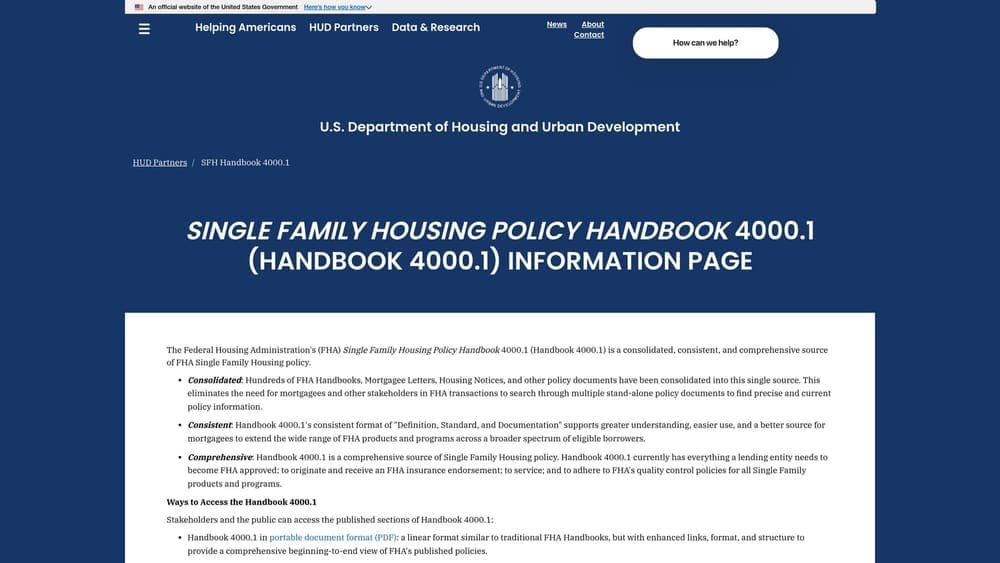
FHA loans are the most accessible government-backed mortgage for high-DTI borrowers, with Automated Underwriting System approvals documented up to 56-57% DTI when compensating factors are present, per HUD Handbook 4000.1.
Where This Tool Shines
The FHA program’s Automated Underwriting System (AUS) is genuinely flexible. When the system issues an “Accept” finding, DTI ratios well above 50% can be approved — not as exceptions, but as standard outcomes. Richmond and Fredericksburg corridor buyers who carry student loans alongside a car payment frequently find FHA to be the only agency product that works for their file.
Compensating factors matter here. Strong cash reserves, low LTV, or documented residual income all improve the odds of an AUS approval at higher DTI levels. Manual underwriting, available when AUS doesn’t issue an approval, caps at 43-45% DTI with compensating factors per HUD guidelines.
Key Features
AUS DTI Flexibility: Automated Underwriting can approve DTI up to 56-57% per HUD Handbook 4000.1 when compensating factors are present.
Low Down Payment: 3.5% down with 580+ FICO; 10% down accepted for scores between 500-579.
Compensating Factors: Cash reserves, residual income, and low LTV all strengthen high-DTI FHA applications.
Statewide Availability: No income limits, no geographic restrictions within Virginia.
DPA Compatible: Easily layered with Dynamo or Turbo down payment assistance programs.
Best For
First-time buyers in Richmond, Fredericksburg, and Hampton Roads who carry student loans or installment debt and need a program that won’t cap them at 43% DTI. Also strong for buyers with moderate credit who want a low down payment path.
Pricing
Upfront MIP of 1.75% of the loan amount; annual MIP of approximately 0.55% for most 30-year loans. Rates vary by lender, which is why shopping through a broker with access to multiple FHA investors matters.
3. VA Loan Program
Best for: Veterans and active-duty borrowers with high DTI and strong residual income
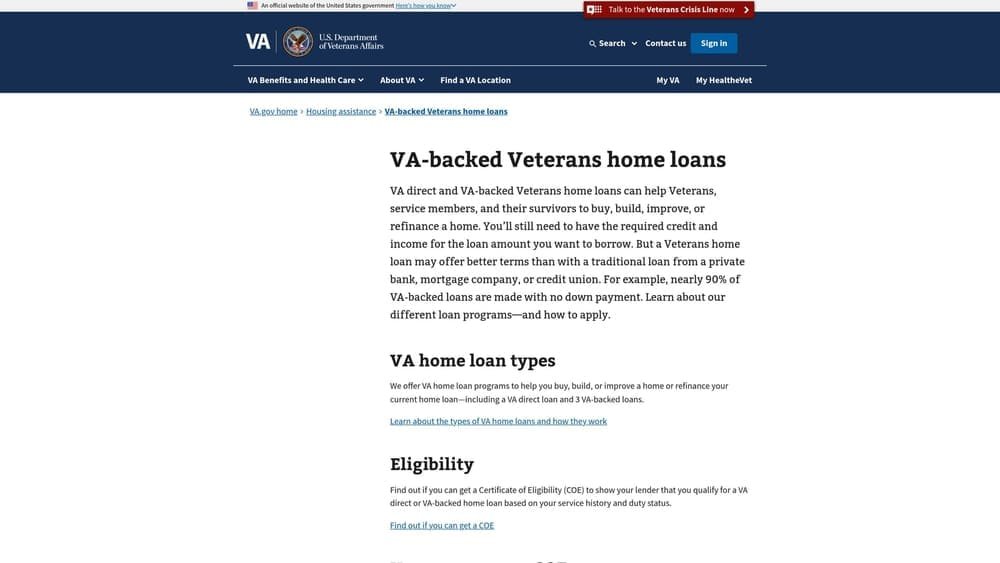
The VA home loan benefit has no published maximum DTI ratio. Approval is governed by residual income analysis, meaning a Virginia veteran with strong take-home pay can often qualify even with a DTI above 55%.
Where This Tool Shines
Residual income is the VA’s secret weapon for high-DTI borrowers. Rather than hard-capping debt ratios, VA lenders verify that after all monthly obligations are paid, the borrower retains enough income to cover living expenses based on family size and geography. A veteran in Hampton Roads or Northern Virginia with a high gross income often passes residual income analysis even when their DTI looks problematic on paper.
For buyers near Quantico, Fort Belvoir, Fort Gregg-Adams, or Naval Station Norfolk, the VA benefit is frequently the most powerful mortgage tool available. Select wholesale lenders access VA loans down to 500 FICO, well below the 620 floor most retail banks enforce.
Key Features
No DTI Maximum: The VA Lenders Handbook (VA Pamphlet 26-7) sets no hard ceiling; residual income governs approval.
No Down Payment Required: 100% financing with no private mortgage insurance.
500 FICO Access: Available through select wholesale lenders, significantly below standard retail minimums.
Military Community Relevance: Especially valuable for Hampton Roads, Northern Virginia, Quantico, and Fort Gregg-Adams communities.
No Monthly PMI: VA funding fee is a one-time cost, waived entirely for veterans with a service-connected disability rating.
Best For
Veterans, active-duty service members, and surviving spouses anywhere in Virginia, particularly those whose DTI is elevated by student loans, car payments, or existing real estate obligations. The strongest program available for military borrowers in high-cost Northern Virginia markets.
Pricing
No down payment required. VA funding fee ranges from 1.25% to 3.3% depending on usage and down payment amount. No monthly PMI. Funding fee waived for disabled veterans.
4. DSCR Loan (Debt Service Coverage Ratio)
Best for: Real estate investors whose personal DTI is inflated by existing rental properties
DSCR loans eliminate personal DTI from the qualification equation entirely. The property’s rental income relative to its mortgage payment is what qualifies the loan, not your W-2 or tax returns.
Where This Tool Shines
If you own multiple rental properties, your personal DTI on paper can look alarming even if every property cash-flows positively. DSCR lending solves this by evaluating each property on its own merits. A DSCR of 1.0 means rent exactly covers the mortgage payment (principal, interest, taxes, insurance, and association dues); most lenders want 1.0 or above, though some allow below-1.0 DSCR with compensating factors.
Virginia Beach, Richmond, and Northern Virginia investors have used DSCR programs aggressively to scale portfolios without hitting personal DTI walls. Short-term rental income from platforms like Airbnb can often be used, with lender-specific documentation requirements.
Key Features
No Personal Income Verification: Property cash flow qualifies the loan; W-2s and tax returns not required.
Flexible DSCR Thresholds: Most lenders require 1.0+; some allow below-1.0 DSCR for strong-credit borrowers.
Property Type Range: Available for single-family, 2-4 unit, and short-term rental properties.
No Financed Property Limits: Many DSCR lenders impose no ceiling on the number of financed properties, unlike conventional guidelines.
Investor-Focused: Popular with Virginia Beach, Richmond, and Northern Virginia investors scaling rental portfolios.
Best For
Experienced Virginia real estate investors whose personal DTI is distorted by existing rental holdings, and self-employed borrowers who want to keep personal finances separate from investment property qualification.
Pricing
Rates typically run 0.5-1.5% above conventional pricing. No personal income documentation required. Non-QM product with pricing that varies by LTV, FICO, and DSCR ratio.
5. Bank Statement Loan
Best for: Self-employed Virginia borrowers whose tax returns understate real income
Bank statement loans use 12-24 months of deposit history as qualifying income, bypassing the Schedule C losses and deductions that inflate DTI on traditional applications for self-employed borrowers.

Where This Tool Shines
Here’s the core problem for self-employed borrowers: tax returns are optimized to minimize taxable income, which means they often show far less income than the borrower actually earns. When a lender runs DTI against Schedule C net income, the ratio can look catastrophic even for a highly profitable business owner. Bank statement loans solve this by using actual cash deposits as the income figure.
Government contractors in Northern Virginia, tech consultants in Charlottesville, and business owners throughout the Richmond metro frequently find that 12-24 months of bank statements show two to three times more qualifying income than their tax returns reflect. The result is a dramatically lower calculated DTI and a much cleaner approval path.
Key Features
Deposit-Based Income: 12 or 24 months of personal or business bank statements replace tax returns entirely.
Expense Factor Applied: Business account deposits are typically subject to a lender-determined expense factor; personal accounts often use a higher percentage of deposits.
DTI Recalculated on Real Income: Qualifying income is based on deposits, not Schedule C net, which often cuts effective DTI significantly.
Full Property Type Coverage: Available for purchase and refinance on primary, second home, and investment properties.
Ideal Borrower Profile: Contractors, consultants, business owners, and gig economy workers throughout Virginia.
Best For
Self-employed Virginia borrowers in any market, especially government contractors in Northern Virginia, UVA-adjacent professionals in Charlottesville, and small business owners in Richmond and Hampton Roads whose write-offs have made traditional mortgage qualification nearly impossible.
Pricing
Non-QM pricing; rates vary by LTV, FICO, loan amount, and statement period used. Typically higher than agency rates, but often the only path to approval for self-employed borrowers with high paper DTI.
6. Conventional Loan via Fannie Mae DU / Freddie Mac LPA
Best for: W-2 borrowers just above 43% DTI with strong credit and reserves
Conventional loans are widely misunderstood on DTI limits. Fannie Mae’s Desktop Underwriter (DU) and Freddie Mac’s Loan Product Advisor (LPA) can issue approvable findings up to 50% DTI when compensating factors are present, per agency guidelines.
Where This Tool Shines
The 43% DTI myth is one of the most persistent misconceptions in mortgage lending. Fannie Mae’s Selling Guide (B3-6-02) explicitly allows DU to approve DTI above 45% when the overall risk profile is strong. For W-2 borrowers in Northern Virginia who earn high salaries but also carry significant housing costs, a DU approval at 48-50% DTI is a real and documented outcome.
The key is compensating factors: a 680+ FICO score, 12 or more months of reserves, stable two-year employment history, and a moderate LTV all contribute to a stronger DU finding. Borrowers who have been told “no” by one conventional lender should understand that the AUS finding, not the loan officer’s gut feeling, is what governs eligibility.
Key Features
AUS DTI Flexibility: Fannie Mae DU and Freddie Mac LPA can issue approvable findings up to 50% DTI per agency guidelines.
Compensating Factors: 680+ FICO, 12+ months reserves, and low LTV all strengthen approval odds at higher DTI levels.
No Upfront MIP: No mortgage insurance with 20%+ down; cancellable PMI once LTV reaches 80%.
2026 Conforming Limits: Baseline conforming loan limit is $806,500 for 2026; high-cost Virginia counties carry higher limits.
Best Fit: W-2 borrowers just over the 43% threshold who have been incorrectly told conventional lending isn’t available to them.
Best For
Salaried borrowers in Northern Virginia, Richmond, and Charlottesville with strong credit and employment history whose DTI falls between 43% and 50%. Often the cleanest path for buyers who want conventional pricing without Non-QM rate premiums.
Pricing
Rates at or near market. PMI required below 20% down payment, but cancellable. No upfront mortgage insurance premium. Typically the lowest long-term cost for qualifying borrowers.
7. Asset Depletion / Asset Dissipation Mortgage
Best for: Retirees and high-net-worth borrowers with significant savings and limited monthly income
Asset depletion loans convert liquid assets into imputed monthly income by dividing eligible account balances by the loan term in months, dramatically reducing calculated DTI for borrowers who are asset-rich but income-light.
Where This Tool Shines
Picture a recently retired professional in Williamsburg or Charlottesville with $1.2 million in a brokerage account and a modest pension. On paper, their monthly income looks thin relative to the mortgage they want, producing a high DTI. Asset depletion solves this by treating that $1.2 million as a stream of imputed income spread across the loan term, creating qualifying income that dramatically improves the DTI calculation.
Retirement accounts are typically discounted (many lenders use 70% of IRA or 401(k) balances to account for tax liability), while liquid brokerage and savings accounts are often counted at full value. Guidelines vary meaningfully by lender, which is another reason having a broker who can shop multiple asset depletion investors is valuable.
Key Features
Asset-to-Income Conversion: Eligible assets divided by loan term in months to create qualifying monthly income.
Retirement Account Discounting: IRA and 401(k) balances typically counted at 70% of value to account for tax liability; varies by lender.
No Employment Required: Ideal for recently retired Virginia homebuyers with no W-2 income.
Full Property Type Coverage: Available for primary residence, second homes, and investment properties.
Virginia Retirement Markets: Particularly relevant for Charlottesville, Williamsburg, and Northern Virginia retirement communities.
Best For
Recently retired borrowers, high-net-worth individuals with substantial investment portfolios, and anyone whose monthly income understates their true financial capacity. Strong credit typically required.
Pricing
Non-QM product; rates vary by lender, LTV, and asset type. Strong credit profile generally required for the best pricing. Not available through retail banks in most cases.
8. Down Payment Assistance (Dynamo and Turbo DPA)
Best for: Buyers whose high DTI is driven by installment debts that could be eliminated before closing
Down payment assistance programs like Dynamo and Turbo do more than cover your down payment. The cash they free up can be used strategically to pay off installment debts before closing, directly cutting your monthly obligations and bringing DTI into range.
Where This Tool Shines
High DTI is sometimes a cash-flow problem in disguise. A borrower who would otherwise drain savings to cover a down payment may have enough liquid funds to eliminate a car loan or personal loan before closing — if they don’t have to use that cash for down payment. DPA programs solve this by covering the down payment, freeing the borrower’s cash to retire debts and reduce DTI.
Paying off a $350 per month car loan, for example, can reduce DTI by three to five percentage points depending on gross income. That single move can convert a declined file into an approved one. Both Dynamo and Turbo are layered on top of FHA loans and are available statewide through wholesale channels.
Key Features
Dynamo DPA: 2.5% or 3.5% assistance, minimum 580 FICO, layered on FHA — accessible to borrowers with moderate credit.
Turbo DPA: 3.5% or 5% assistance, minimum 600 FICO, layered on FHA, up to 101.5% combined LTV.
Debt Payoff Strategy: Freed cash can eliminate car loans or installment debts pre-closing, directly reducing monthly DTI.
DTI Impact: Retiring a $350/month installment debt can reduce DTI by three to five percentage points depending on income.
Statewide Availability: Available throughout Virginia; income limits may apply depending on the specific program structure.
Best For
First-time buyers in Richmond, Fredericksburg, and Hampton Roads who are close to the DTI threshold and have installment debts that could be retired before closing. Also strong for buyers who want to preserve cash reserves while minimizing out-of-pocket costs.
Pricing
DPA is typically structured as a second lien at a fixed rate. Little to nothing out of pocket at closing is possible when DPA is properly structured. First lien FHA MIP applies as standard.
9. USDA Rural Development Guaranteed Loan
Best for: Virginia buyers in suburban and rural areas who need 100% financing with flexible DTI
USDA Rural Development Guaranteed Loans are one of the most underused mortgage programs in Virginia. The GUS automated system approves DTI up to 46%, and manual underwriting allows higher ratios with compensating factors, all with no down payment required.
Where This Tool Shines
Many Virginia buyers dismiss USDA without ever checking the eligibility map, assuming it only applies to farmland. In reality, USDA-eligible areas include substantial portions of Spotsylvania, Stafford, Albemarle County, and dozens of rural and exurban Virginia communities where buyers are actively purchasing homes. Buyers in the outer Fredericksburg corridor and parts of the Northern Neck frequently qualify.
The combination of no down payment, no monthly PMI (replaced by a lower annual guarantee fee), and DTI flexibility up to 46% through GUS makes USDA one of the most cost-effective high DTI mortgage solutions available for eligible borrowers. Manual underwriting can push that DTI ceiling higher when compensating factors are documented, per USDA HB-1-3555.
Key Features
GUS DTI Approval: Guaranteed Underwriting System can approve DTI up to 46% for guaranteed loans per USDA HB-1-3555.
Manual Underwriting Option: Higher DTI allowed with documented compensating factors when GUS doesn’t issue an approval.
No Down Payment: 100% financing available — one of only two government programs offering this (alongside VA).
Lower Ongoing Costs: No monthly PMI; annual guarantee fee of 0.35% is lower than FHA’s annual MIP for most borrowers.
Virginia Eligible Areas: Spotsylvania, Stafford, Albemarle, and many rural Virginia counties qualify — always verify at the USDA eligibility map.
Best For
Moderate-income Virginia buyers purchasing in suburban or rural communities who need 100% financing and have DTI ratios between 43% and 46%. Household income limits apply and vary by county and family size.
Pricing
1% upfront guarantee fee plus 0.35% annual fee. No down payment required. Income limits apply by household size and county. Verify eligibility before application.
Which High DTI Solution Fits Your Situation
The right program depends entirely on your income type, credit profile, and how far above the standard DTI threshold you sit. Here’s a quick breakdown by borrower type.
Veterans and active-duty military: Start with VA. No DTI ceiling, no down payment, no PMI. If you’re near Quantico, Fort Belvoir, or Hampton Roads, this is almost always the strongest option on the table.
Self-employed borrowers: Bank statement loans recalculate your income based on deposits, not Schedule C losses. Government contractors in Northern Virginia and business owners in Richmond and Charlottesville frequently qualify for significantly more than their tax returns suggest.
Real estate investors: DSCR loans remove personal DTI entirely. If your portfolio is growing and your personal ratios are getting crowded, this is the path that scales.
W-2 borrowers just over 43%: Run your file through conventional AUS first. Fannie Mae DU and Freddie Mac LPA can approve up to 50% DTI with the right compensating factors, and conventional pricing beats Non-QM rates.
First-time buyers with installment debt: FHA plus Dynamo or Turbo DPA can free up cash to retire debts before closing, bringing DTI into range while preserving reserves.
Retirees and asset-rich borrowers: Asset depletion converts your portfolio into qualifying income. Especially relevant in Charlottesville, Williamsburg, and Northern Virginia retirement communities.
Suburban and rural buyers: Check USDA eligibility before assuming you don’t qualify. Spotsylvania, Stafford, and Albemarle County buyers are often surprised to find they’re in an eligible zone.
The fastest way to know which of these nine paths works for your specific file is a soft pull mortgage broker review that prices all of them simultaneously. With a no hard inquiry mortgage pre-approval, you can see real options across every program without any credit score impact. Get your free mortgage review today and find out what Virginia’s top-ranked mortgage broker can do for your DTI situation.